The circle of fifths, explained: keys, chords, and what musicians actually use it for
The circle of fifths is the visual map of all 12 major and minor keys, organized by ascending fifths. It is the most useful single diagram in Western music theory, and the one tool every musician eventually learns to read fluently. This article explains what it is, how it works, and what to actually do with it.
The circle of fifths is the visual map of all twelve major and minor keys, arranged so that adjacent keys differ by one accidental (sharp or flat). C major sits at the top with no sharps or flats; moving clockwise, each key adds one sharp; moving counterclockwise, each key adds one flat. After twelve steps in either direction, the circle closes and you are back where you started.
It is the most-printed single diagram in Western music theory, and one of the few tools every working musician eventually internalizes. This article explains what it is, why it is shaped the way it is, and the practical things musicians actually do with it.
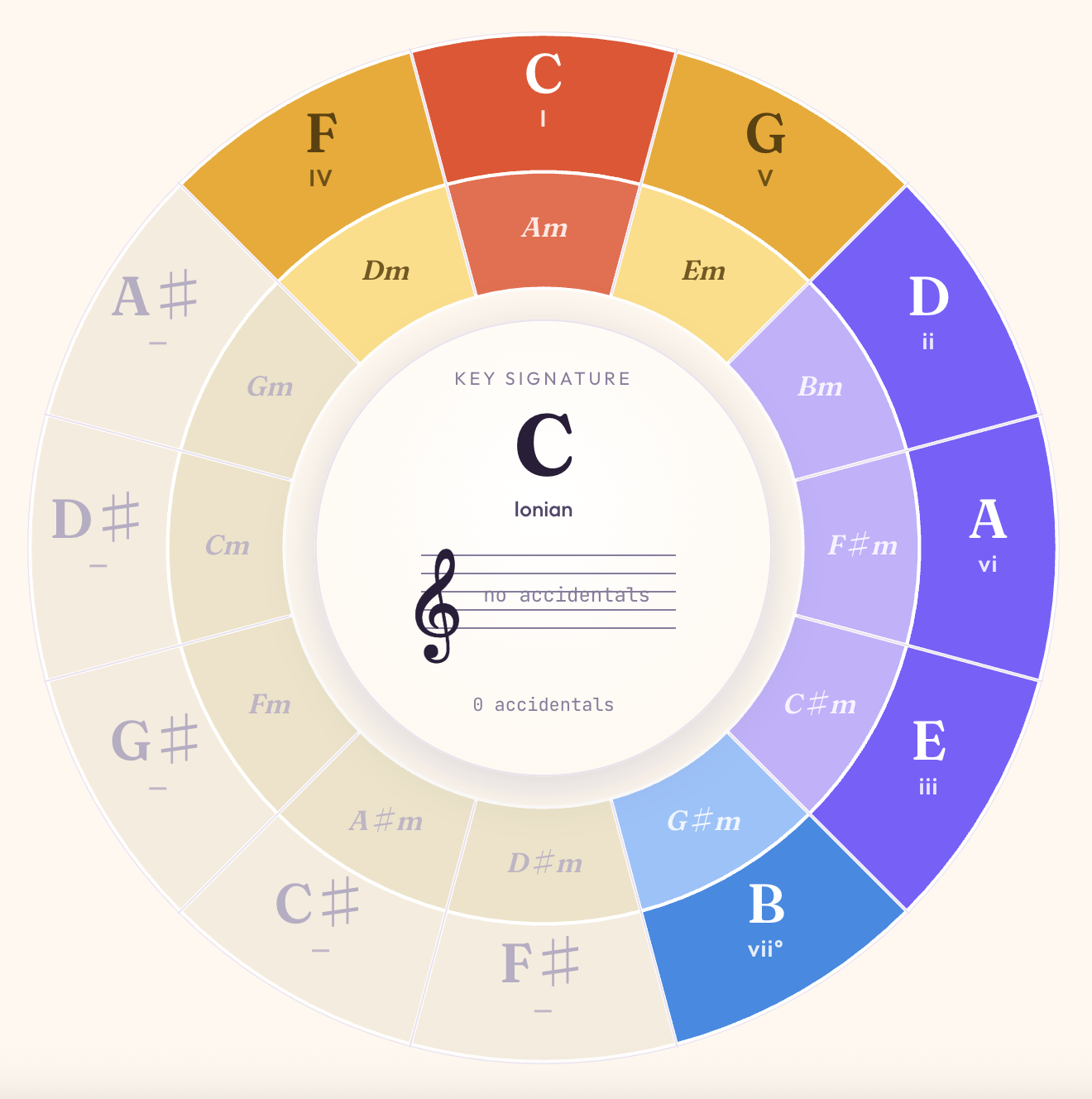
Want to explore as you read? Open our interactive circle of fifths — click any key to hear it, switch between major and minor, and see the diatonic chords for each key.
The basic shape
Reading clockwise from C, the major keys are:
C → G → D → A → E → B → F♯ → C♯ → A♭ → E♭ → B♭ → F → C
Each step clockwise raises the previous key by a perfect fifth (C up to G, G up to D, D up to A, …). Each step adds exactly one sharp to the key signature: C has none, G has one (F♯), D has two (F♯, C♯), A has three, and so on, all the way to C♯ major with seven sharps.
Reading counterclockwise from C, you get the same twelve keys named flatward:
C → F → B♭ → E♭ → A♭ → D♭ → G♭ → C♭
Each step counterclockwise drops the previous key by a perfect fifth (or, equivalently, raises by a perfect fourth) and adds one flat to the key signature.
Three pairs of keys are enharmonically equivalent — they sound the same but are written differently. F♯ major (six sharps) is the same as G♭ major (six flats). C♯ major (seven sharps) is the same as D♭ major (five flats). C♭ major (seven flats) is the same as B major (five sharps). Which spelling you use depends on the harmonic context.
Why the keys are arranged this way
The circle is organized by perfect fifths because changing key by a perfect fifth is the smallest possible change to a key signature. Adding one sharp or removing one flat moves you exactly one step around the circle. Every other interval-based reordering of the keys would scatter accidentals.
This makes the circle the natural representation of key proximity: two keys that sit next to each other on the circle (C major and G major, say) share six of seven scale notes, and modulating between them is gentle. Two keys on opposite sides of the circle (C major and F♯ major) share only one scale note, and modulating between them is jarring. The circle is, in this sense, a map of which key changes feel related.
Minor keys: relative minors live on the inside
Every major key has a relative minor — a minor key with the exact same key signature, whose tonic is the sixth scale degree of the major key. C major’s relative minor is A minor (no sharps or flats). G major’s relative minor is E minor (one sharp). D major’s relative minor is B minor (two sharps). And so on.
In a typical printed circle of fifths (like the one pictured above), the minor keys are written inside the circle, lined up with their relative majors. Each major and its relative minor share a key signature — they’re effectively the same set of seven notes, organized around two different tonal centers.
| Major key | Relative minor | Sharps / flats |
|---|---|---|
| C | A minor | — |
| G | E minor | 1♯ |
| D | B minor | 2♯ |
| A | F♯ minor | 3♯ |
| E | C♯ minor | 4♯ |
| B | G♯ minor | 5♯ |
| F♯ / G♭ | D♯ / E♭ minor | 6♯ / 6♭ |
| D♭ | B♭ minor | 5♭ |
| A♭ | F minor | 4♭ |
| E♭ | C minor | 3♭ |
| B♭ | G minor | 2♭ |
| F | D minor | 1♭ |
A brief history
The systematic codification of the circle is usually attributed to Johann David Heinichen, whose 1728 treatise Der General-Bass in der Composition (Dresden) presented it in essentially its modern form [1]. Earlier proto-versions appeared in Nikolay Diletsky’s 1679 Russian Ideja gramatiki musikijskoj and elsewhere; the underlying observation that keys can be ordered by fifths was older still, going back to the medieval Guidonian hexachord and the Pythagorean tuning literature.
The circle solved a practical problem: as Western music moved from the church modes into the equal-tempered major/minor system in the 17th and 18th centuries, composers needed a way to think about modulation between keys, and the circle gave them one.
What musicians actually use it for
The circle is not just a memorization aid. Working musicians use it for at least five recurring tasks.
1. Reading and remembering key signatures
The most basic use: knowing how many sharps or flats a given key has. E major — count clockwise from C — that’s four steps, so four sharps. D♭ major — count counterclockwise — five steps, so five flats. The mnemonic phrases (“Father Charles Goes Down And Ends Battle” for the order of sharps; reverse for flats) work, but the circle is faster once you’ve internalized it.
2. Diatonic chord progressions
The strongest chord progression in tonal music — the V → I cadence — is, by definition, a fifth-down resolution. Chord progressions that move predominantly in fifths (especially the ii → V → I of jazz and the vi → ii → V → I of pop) trace paths along the circle. Looking at a chord chart and thinking in terms of “are we moving with the circle or against it?” gives you a fast read on the progression’s shape.
Specifically, the circle-of-fifths progression (also called the “fifths sequence”) moves through chords whose roots descend by fifths: C → F → B♭ → E♭ → A♭ → D♭ → G♭ → B → E → A → D → G → C. Pop and jazz are full of partial circle-of-fifths progressions, often disguised by reharmonization.
3. Modulation distance
When a piece changes key, the number of steps on the circle gives you a quick sense of how dramatic the modulation will sound. Modulating from C major to G major is gentle — adjacent on the circle, six shared notes. Modulating from C major to E♭ major is more dramatic — three steps away, four shared notes. Modulating to F♯ major is severe — opposite the circle, one shared note.
4. Key-rotation practice (jazz pedagogy)
In jazz education, vocabulary (a lick, a voicing, a sequence, a tune) is considered learned only when it has been practiced in all twelve keys. The standard practice routes are: chromatically (one half-step at a time), in fourths/fifths (around the circle counterclockwise), and randomly. The fifths-rotation is the most musical of the three — adjacent keys share most of their notes, so transposing each fifth feels like moving the same pattern to a slightly tilted version of the same harmonic landscape. (See The 12-key practice tradition.)
5. Quick transposition
If you need to play a song a different key — to fit a singer’s range, to match another instrument, to make it easier on a particular instrument — the circle tells you how many sharps or flats you’ll be dealing with in the new key. Transposing from G major to D major adds one sharp; transposing from G major to E♭ major changes from one sharp to three flats, a much bigger conceptual jump.
What it looks like in practice
A standard printed circle of fifths is a wheel: twelve sectors, the major key letter on the outside, the relative minor on the inside, the key-signature accidentals (♯ or ♭ count) at the rim. Most music classrooms have one on the wall.
Many digital and interactive versions show additional information on top of the basic structure — the diatonic chords for each key, common-tone modulations, mode shifts (parallel minor, parallel major), or chord substitutions. These are useful study tools but are extensions of the basic circle, not the circle itself.
Try it yourself: Our interactive circle of fifths plays each chord, shows the key signature, and lets you switch tonic and mode in one click — so you can hear modulation distance instead of just reading about it.
Why the circle is the foundation of ear training for harmony
The skill of hearing where you are in a key — and hearing when the key has changed — is, at the most abstract level, the skill of perceiving your position on the circle. A trained ear hears a V → I resolution as a one-step move (the dominant returning home); hears a deceptive cadence (V → vi) as a sidestep; hears a tritone substitution as a two-step jump that resolves like a fifth. The pedagogical sequence — first hearing tonic, then dominant function, then subdominant function, then modulation distance — maps onto the circle naturally.
This is why apps and curricula serious about harmonic ear training organize their lessons in roughly the same order: tonic identification → V/I cadence hearing → diatonic chord function → secondary dominants → modulation. Each step adds one more circle-of-fifths concept to the listener’s working vocabulary.
FAQ
What’s the difference between the circle of fifths and the circle of fourths? They are the same circle read in opposite directions. Clockwise = ascending fifths (or descending fourths). Counterclockwise = descending fifths (or ascending fourths). Most jazz pedagogy refers to “the circle of fourths” because the standard practice direction is counterclockwise; classical pedagogy more often calls it “the circle of fifths.” Either name is correct.
Why are there 12 keys and not 7? There are seven natural notes (A through G), but each can be the tonic of a major or minor key, and key signatures distinguish them by their accidentals — sharps and flats. The 12-tone equal-tempered system gives 12 unique pitch classes (C, C♯/D♭, D, D♯/E♭, E, F, F♯/G♭, G, G♯/A♭, A, A♯/B♭, B), and each can be the tonic of a major or minor key, giving 12 majors and 12 minors. The circle has 12 positions because of this.
Do I need to memorize the circle to be a musician? You don’t need to draw it from memory, but most working musicians do internalize it over time. Reading sheet music in any key, transposing on the fly, hearing common chord progressions, and practicing in 12 keys all become much easier once the circle is fluent.
What about the diminished circle / chromatic circle? The chromatic circle (twelve semitones in a wheel) is a different visualization — useful for atonal and dodecaphonic music. The “diminished circle” is informal terminology for cycles of minor thirds (which form a four-note diminished seventh chord); it shows up in some jazz pedagogy as a complement to the standard circle.
References
Heinichen, J. D. (1728). Der General-Bass in der Composition. Dresden. The 1728 treatise contains what is generally cited as the first published version of the modern circle of fifths in essentially its current form. For the broader pre-history, see also: Diletsky, N. (1679). Idea grammatiki musikiyskoy (“Idea of Musical Grammar”), which contains an earlier visual ordering of keys by fifths. ↩︎